X-Men '97 Explained: How Apocalypse Rose to Power in Ancient Egypt
Marvel Animation's X-Men '97 revisits the origin of Apocalypse. This explainer traces how the outcast mutant En Sabah Nur was forged in the Egyptian desert, swore vengeance on the Kang variant Rama-Tut, built his First Horsemen and Clan Akkaba, and embraced a Celestial mandate that made him the X-Men's most ancient foe.

Few villains cast a longer shadow over mutant history than Apocalypse, the near-immortal conqueror born as one of Earth's very first mutants roughly 5,000 years ago. As Marvel Animation's X-Men '97 turns its gaze toward his ancient beginnings, this explainer traces how a gray-skinned outcast abandoned in the Egyptian desert became the self-appointed arbiter of "survival of the fittest."
Key Details
- Character: Apocalypse, born En Sabah Nur, is one of the world's oldest known mutants and a recurring adversary of the X-Men.
- Series: He returns in Marvel Animation's X-Men '97 Season 2 on Disney+, following his clashes with the team in X-Men: The Animated Series.
- Comics debut: The villain first appeared in Marvel Comics' X-Factor in 1986; his ancient origin was later chronicled across the Rise of Apocalypse limited series in 1996.
- Ethos: A ruthless belief in "survival of the fittest," forged through a brutal desert upbringing.
- Key ties: Rama-Tut (a variant of Kang the Conqueror), the god-like Celestials, his First Horsemen, and the loyal Clan Akkaba.
The Birth of En Sabah Nur in Ancient Egypt
Mutants may represent the next stage of human evolution, but they are far from a modern phenomenon, and few have marked history as indelibly as Apocalypse. Around five millennia ago, near the Valley of the Kings, an infant was born whose gray skin so unnerved his own Akkaban tribe that they left him to die in the desert. That child was rescued when a band of nomadic raiders called the Sandstormers razed Akkaba, and their leader, Baal of the Crimson Sands, took the foundling as his own in Rise of Apocalypse (1996) #1 by writer Terry Kavanagh and artist Adam Pollina.
Baal named the boy En Sabah Nur. Though Nur was said to be a kind and generous child, Baal deliberately hardened him, treating adversity as a forge for strength. As the young mutant's powers surfaced and made him extraordinarily strong, the other Sandstormers still cast him as an outsider. It was under Baal that Nur absorbed the "survival of the fittest" creed that would define him for thousands of years.


The Rama-Tut Prophecy and a Vow of Vengeance
As Nur grew, Egypt fell under the rule of the Pharaoh Rama-Tut, a variant of the time-traveling Kang the Conqueror who first appeared in Fantastic Four (1961) #19 by Stan Lee and Jack Kirby. After his time machine crashed near 2950 BCE, Rama-Tut was healed by Baal's people before seizing the kingdom with futuristic technology. Fearing that this powerful young mutant might one day grow into a rival conqueror, the pharaoh sought to claim him as an heir, a scheme Baal had long anticipated when he adopted Nur.
Baal eventually revealed the truth to the teenage Nur, framing the defeat of Rama-Tut as his destiny. Their search for the pharaoh's Sphinx-shaped ship ended in tragedy when the pair became trapped underground, and Baal perished from thirst and starvation in Rise of Apocalypse (1996) #2. Kept alive by his own mutant physiology, Nur swore vengeance and slipped, masked, among the enslaved masses laboring for the pharaoh.
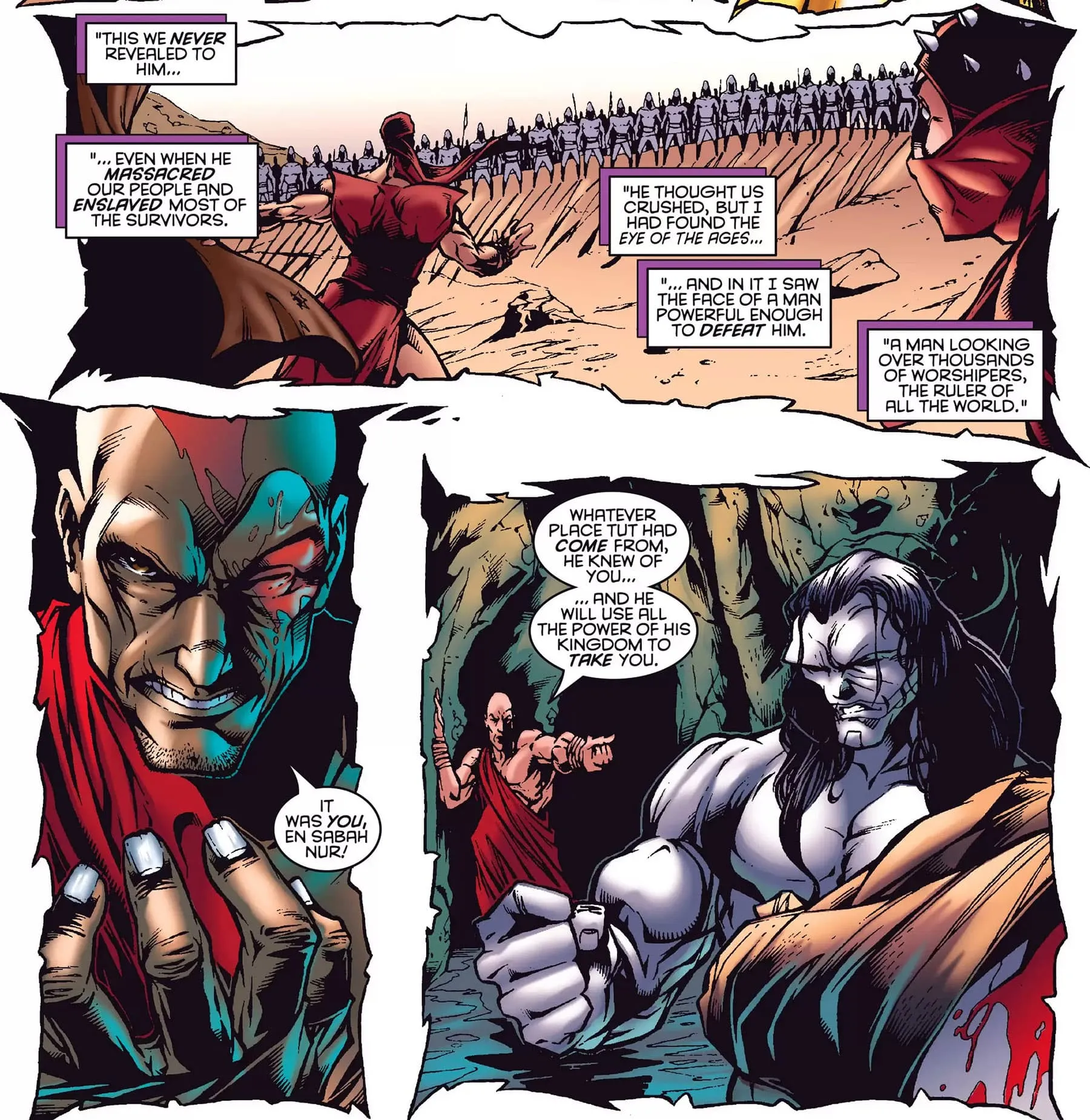
Apocalypse vs. Rama-Tut: The Making of a Conqueror
Nur's abilities kept evolving into adulthood, and when a vision of the goddess Isis awakened new powers, he was captured and hauled before Rama-Tut, who again offered to make him heir in Rise of Apocalypse (1996) #3. His refusal was met with cruelty: the pharaoh executed his adviser Logos and exposed his mutant face to Nephri, the woman he loved, who recoiled from him. Rama-Tut then struck him with a device that had just depowered the time-lost Fantastic Four.
Cast into a snake pit alongside Nephri in Rise of Apocalypse (1996) #4, Nur unlocked shape-shifting and size-changing abilities. As Rama-Tut battled the Fantastic Four and fled to his own era, the mutant seized the pharaoh's ship. When he strode out of the Sphinx, servants bowed and Nephri begged him back, but he spurned them all as weak, later returning to taunt an aged Nephri with his immortality. The transformation was complete: En Sabah Nur was now Apocalypse.

From the Brood Invasion to a Celestial Destiny
With Baal and Rama-Tut behind him, Apocalypse expanded his reach across the ancient world. On the South Pacific island of Okkara he wed a mutant named Genesis and fathered four formidable children, Pestilence, War, Famine, and Death, who became his original First Horsemen. When the parasitic alien Brood invaded, a warrior named Imhotep rallied Egypt's champions in S.H.I.E.L.D. (2010) #1 by Jonathan Hickman and Dustin Weaver, and Apocalypse fought alongside that era's Moon Knight to repel them, inspiring the Brotherhood of the Shield that would one day become S.H.I.E.L.D. His victory came at a cost, as the Horsemen were later lost to the hellish dimension of Amenth for ages.
Over the centuries Apocalypse cultivated the mutant bloodline known as Clan Akkaba and a band of human zealots called the Dark Riders. His travels brought him into conflict with an immortal named Saul aboard a ship built by the god-like Celestials in X-Force (1991) #37, whose technology he studied to forge power-enhancing bio-armor. A later encounter with a Celestial in X-Men (2004) #186 granted him leave to keep using their tools, provided he drove mutantkind forward, cementing the merciless "testing" of mutants that would eventually target the X-Men.


What This Means for X-Men '97 Fans
Apocalypse is no simple monster of the week. Every cruelty he inflicts stems from a philosophy that was beaten into him in the Egyptian sands, which is precisely what makes him such a compelling threat as X-Men '97 Season 2 revisits his rise. Understanding En Sabah Nur's origins, his grudge against a Kang variant, and his Celestial mandate to cull the weak gives fans a clearer sense of the stakes when this ancient conqueror once again sets his sights on Marvel's mutants. His story is a reminder that the X-Men are not only fighting for the future, but against the very deep past that shaped their world.