Marvel Heroes Who Revealed Their Secret Identities — And the Comics That Changed Everything
From Tony Stark's televised unmasking to Spider-Man's Civil War press conference, some of Marvel's most famous heroes have stepped out from behind the mask. Here's a look at the comic book moments that retired the secret identity for Iron Man, Captain America, Spider-Man, Daredevil, She-Hulk, Professor X, and Dazzler.

Everybody has secrets — but in the Marvel Universe, some heroes decided that hiding behind a mask wasn't worth the cost. From Tony Stark's televised unmasking to Spider-Man's career-altering Civil War press conference, here are the comic book moments when Marvel's most famous Super Heroes stepped out into the open and changed their stories forever.

Identities like Spider-Man and Daredevil spent decades acting as protective walls between costumed heroes and the people they loved. But across roughly six decades of Marvel Comics, several heroes have decided the wall wasn't worth the toll — for political, personal, or career reasons. Here's how the most influential unmaskings unfolded.
Iron Man: The First Public Hero
For most of his early appearances, Tony Stark hid behind the convenient lie that Iron Man was his "personal bodyguard" — a useful fiction that gave the world's flashiest billionaire an excuse to be seen with a flying suit of armor. He briefly stepped back into the closet, but the Superhuman Registration Act ended that secret for good.

In Civil War: Front Line (2006) #1 by Paul Jenkins and Ramon Bachs, Tony unmasks himself once and for all to back the legislation he chose to enforce. He's been a publicly known hero ever since, with all the corporate, political, and personal complications that come with it.
Captain America: Taking Public Responsibility
Captain America's unmasking happened twice. The first came in Tales of Suspense (1959) #95 by Stan Lee and Jack Kirby, when Steve Rogers briefly came forward to announce his retirement.

The permanent reveal came in Captain America (2002) #3 by John Ney Rieber and John Cassaday. After killing an extremist leader on live television, Captain America wanted to take personal responsibility for what he'd done — so he unmasked on a live broadcast. It's a move very few heroes have the moral standing to pull off.
Spider-Man: The Most Famous Unmasking in Comics
If there's a single panel that defines the modern era of Marvel Comics, it's Peter Parker stepping up to a podium during Civil War (2006) and pulling off the mask. He'd moved into Avengers Tower with Mary Jane Watson and Aunt May, found a mentor in Tony Stark, and accepted the Iron Spider suit Stark had built him.
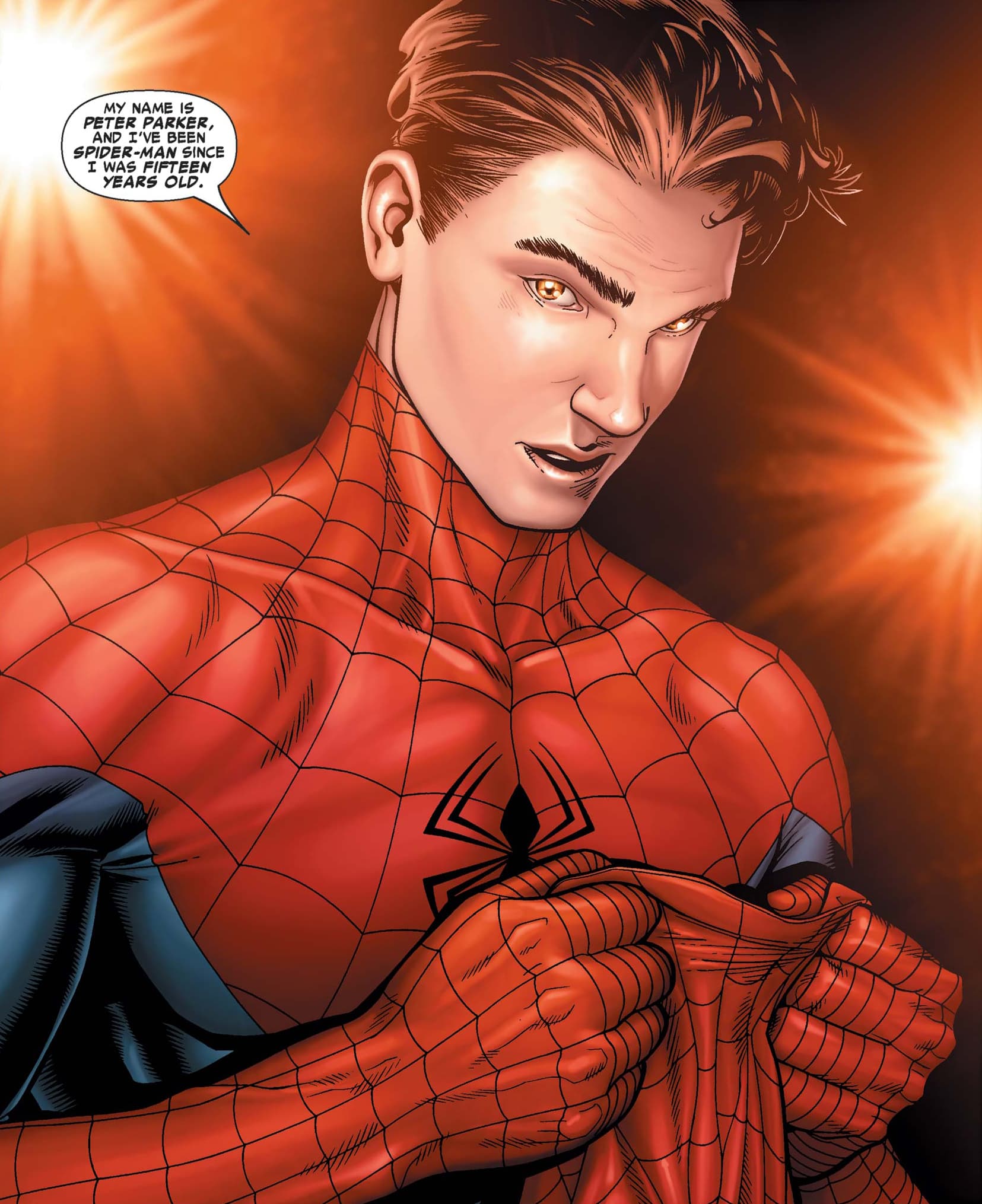
The fallout was enormous. Kingpin put a hit on the Parker family, and the consequences eventually fed into One More Day, the editorial reset that magically scrubbed Peter's identity from the world's memory. It remains one of the most consequential and most argued-about story decisions in modern comics.
Daredevil: An Identity Sold to the Tabloids
Daredevil's secret has slipped on multiple occasions, often without his consent. The most damaging blow came when F.B.I. agent Henry Dobbs sold Matt Murdock's identity to the Daily Globe, igniting years of speculation, lawsuits, and a now-iconic "I'm Not Daredevil" sweater that Matt wore as a public dodge.

The voluntary reveal came in Daredevil (2011) #35 by Mark Waid and Chris Samnee, when Matt outed himself in a New York courtroom to expose a conspiracy involving the Sons of the Serpent. The choice cost him his law license — but gave him a new mission.
She-Hulk: Spell, Reversed
When Jennifer Walters received Bruce Banner's life-saving blood transfusion, she also inherited the gamma-irradiated DNA that turns her into She-Hulk. Unlike her cousin, Jennifer thrived — she became more confident, more outgoing, and more publicly visible in her green form.

To protect her career, Jennifer asked the Scarlet Witch for a spell that would mask her identity from anyone who meant her harm — a brilliant, very lawyerly workaround. The spell hasn't always held, and Jennifer's identity has become one of comics' more flexible secrets.
Professor X: A Mutant Outed Against His Will
For decades, Charles Xavier's mutant powers and X-Men involvement were quiet open secrets — widely suspected, never confirmed. That ended when his evil twin Cassandra Nova hijacked his body and outed him as a mutant on a global stage.

The reveal in New X-Men (2001) #116 by Grant Morrison and Frank Quitely turned the Xavier School for Gifted Youngsters into a flashpoint, attracting both new students and anti-mutant protestors. When Charles regained control of his mind and body, he chose not to telepathically rewrite the world — an unusually restrained move for a man who could.
Dazzler: Outed at the Worst Possible Moment
Alison Blaire built her stage career as Dazzler, a pop musician famous for her dazzling light shows. The catch: those light shows were her actual mutant powers, which she'd kept secret even from most of her bandmates and X-Men allies.

In Marvel Graphic Novel: Dazzler — The Movie (1984) #1 by Jim Shooter and Frank Springer, Alison tried to use jet engine noise to power a massive on-stage display — only for the press to panic and her career to crater. Dazzler's reveal is one of the bleaker examples in this list, a reminder that going public hasn't always paid off in the Marvel Universe.
What This Means for Marvel Fans
Reading these moments back-to-back is a useful reminder of how much Marvel Comics has used the secret identity as a storytelling pressure valve. Every reveal carries a cost — family, careers, peace of mind — and the writers behind these issues used those costs to push the characters into new eras. If you want to dive deeper, all of these issues are available on Marvel Unlimited, which gives readers digital access to 30,000+ comics spanning Marvel classics through ongoing series. Pick one unmasking you only know secondhand — Civil War or New X-Men #116 are great starting points — and read it from the inside.