Inside Spider-Man Noir's World: The Heroes and Villains of Earth-90214 Explained
Marvel revisits the moody 1930s reality of Spider-Man Noir, breaking down the friends and foes who define Earth-90214 — from a gun-toting Peter Parker to the reptilian Goblin, nightclub-owner Felicia Hardy, and a stone-skinned Tombstone. A perfect primer for fans who met the character in the Spider-Verse films.

There is a corner of the Marvel Multiverse where every neon sign flickers, every alley hides a secret, and justice is dealt in shades of gray rather than red and blue. It is the world of Spider-Man Noir — and ahead of the character's renewed spotlight, Marvel has pulled back the curtain on the friends and foes who populate his rain-slicked 1930s New York.

Welcome to Earth-90214: The Marvel Noir Universe
For readers new to the alternate reality, Marvel Noir — officially designated Earth-90214 — reimagines the publisher's most iconic heroes and villains inside a stylized Great Depression-era America. Crooked cops, mob bosses, jazz clubs, and pulp-magazine menace replace the gleaming skyscrapers and cosmic threats of the mainline Marvel Universe. It is a setting where heroism costs something, and where the line between vigilante and criminal is razor-thin.
Casual fans likely first met this version of the web-slinger on the big screen: a black-and-white, trench-coated Spider-Man Noir, voiced by Nicolas Cage, was a breakout favorite in 2018's Oscar-winning Spider-Man: Into the Spider-Verse. But the comics that inspired him run far deeper. Here is the rogues' gallery and supporting cast that define his world.
Where to Start Reading
- First appearance: Spider-Man Noir (2008) #1, by David Hine, Fabrice Sapolsky, and Carmine Di Giandomenico
- Key sequels: Spider-Man Noir: Eyes Without a Face (2009), Edge of Spider-Verse (2014) #1, and Spider-Man Noir (2020) by Margaret Stohl and Juan Ferreyra
- Reality: Earth-90214, the Marvel Noir Universe
- Where to read: Marvel Unlimited (30,000+ digital issues)
Spider-Man (Peter Parker)
Debuting in Spider-Man Noir (2008) #1, this Peter Parker worked for crusading photojournalist Ben Urich to pay for college after his Uncle Ben was murdered by thugs in the employ of crime lord Norman Osborn. While investigating a shipment of stolen artifacts in one of Osborn's warehouses, Peter shattered an ancient spider idol and unleashed a swarm of supernatural spiders. Bitten by one, he received a vision from a spider demigod that granted him superhuman strength, speed, and endurance — along with the ability to weave organic dark webbing from his wrists.

Rather than spandex, this Spidey fashioned a costume from his uncle's World War I aviator uniform and armed himself with firearms — a striking departure from the wisecracking hero fans know. Beyond battling super-powered crime lords like Osborn, he even thwarted a Nazi attempt to gain a foothold in New York in Spider-Man Noir: Eyes Without a Face (2009).
Norman Osborn, "the Goblin"
Few villains have scarred Peter Parker's life like Norman Osborn. Unlike his Earth-616 counterpart, the Noir Osborn earned the nickname "the Goblin" thanks to a strange, reptilian skin condition, hiding his monstrous visage behind a custom mask. He ruled New York's underworld and kept lethal enforcers like the Chameleon and Kraven on his payroll. After Spider-Man Noir unmasked him publicly, a spider-maddened Kraven went on a rampage that seemingly killed the Goblin in Spider-Man Noir (2008) #4.

Felicia Hardy, the White Widow
The ultimate femme fatale in any universe, Felicia Hardy is no cat burglar here. Instead, she owns the Black Cat nightclub and serves as a trusted ally — and former lover — of Ben Urich. Introduced in Spider-Man Noir (2008) #1, she funneled tips from her club's shady clientele to Urich and Spider-Man. After her boyfriend, the Crime Master, turned on her violently upon learning of her allegiance, Felicia recovered and took up the masked identity of the White Widow to fight crime alongside the wall-crawler.

Sandman
Spider-Man has a long history with elemental villains, and Sandman ranks among the most prolific. On Earth-616, small-time crook Flint Marko gained his powers crossing irradiated sand; in the Noir reality, Sandman earned his nickname through a granite-like physique, becoming notorious for dealing fatal blows with his bare hands. Introduced in Spider-Man Noir: Eyes Without a Face (2009) #1 as an enforcer for the Crime Master, he nearly killed the web-slinger — until this universe's Jean DeWolff intervened in the nick of time.

Electro
One of Spidey's most electrifying foes is also one of his oldest. While Max Dillon became living energy on Earth-616, the Noir Electro rigged a set of experimental Tesla coils and fired bolts through a modified lightning rod. He made his Noir debut in Spider-Man Noir (2020), by Margaret Stohl and Juan Ferreyra — but met an untimely fate, monstrously transformed by the M'kraan Crystal inside an ancient temple, only to be consumed by an evil demigod.

Robbie Robertson
The sequel Spider-Man Noir: Eyes Without a Face (2009) #1 introduced Robbie Robertson, a journalist working alongside Peter just like his mainstream counterpart. Alarmed by a wave of disappearances in Harlem and frustrated by police indifference, Robbie investigated and uncovered a sinister plot by this reality's Otto Octavius, who abducted and lobotomized his victims. Robbie met a tragic end as one of those victims — and Spider-Man took down the mad scientist for good to avenge his friend.
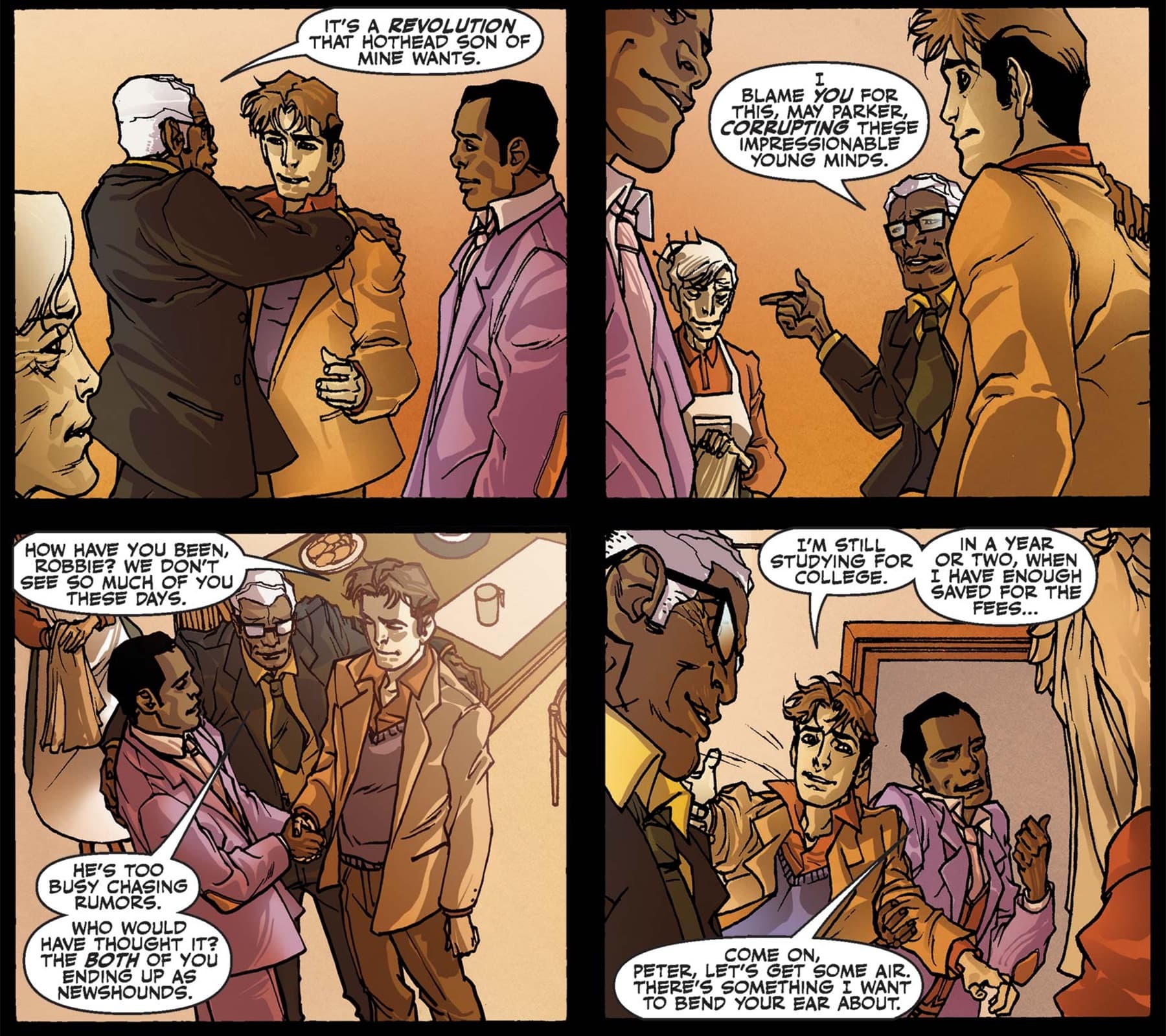
Mysterio
When Hollywood effects whiz Quentin Beck turned his talents to crime, he became Mysterio — and the Noir version kept every ounce of theatrical flair, dazzling crowds as a magician at the World's Fair in Edge of Spider-Verse (2014) #1, by Hine, Sapolsky, and artist Richard Isanove. After holding Felicia Hardy hostage before a live audience, Mysterio disoriented Spider-Man with noxious gas — but the hero saw through the illusions just as he was recruited to help stop an extra-dimensional threat across the Spider-Verse.

Tombstone
A towering mob enforcer with filed teeth, Tombstone made his Noir debut not in a Spider-title but in Luke Cage Noir (2009) #1, by Mike Benson, Adam Glass, and Shawn Martinbrough, as a corrupt Harlem cop with mob ties. In this reality, Lonnie Lincoln's strength and endurance stemmed from a congenital condition that progressively hardened his skin. After he threatened Luke Cage and his loved ones, the hero defeated him by overloading him with gas in Luke Cage Noir (2009) #4.

Why This Matters for Marvel Fans
Spider-Man Noir's enduring appeal lies in how completely it reinvents familiar faces: the same names, the same archetypes, filtered through pulp fiction and Depression-era desperation. With the character a fan-favorite from the Spider-Verse films and the subject of renewed comics attention, revisiting his rogues' gallery is the perfect on-ramp for anyone curious about Marvel's moodiest reality. Every issue mentioned above is available on Marvel Unlimited — and there has rarely been a better moment to step into the shadows of Earth-90214.